All posts by Mindful tester

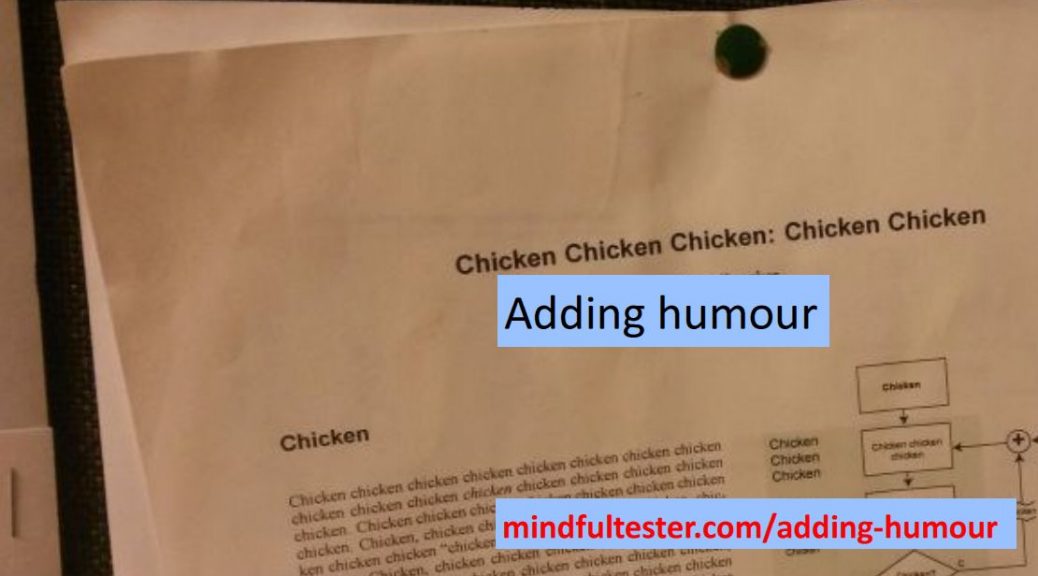
Adding humour

Expect the unexpected

In a white room I was asking questions. After each answer I posed a new question. Then I asked something and the whole joke collapsed. Nobody noticed, but I had taken a wrong turn. I felt bad.

The white walls vanished. I realised that I was having lunch at the kitchen table. One of my kids looked curiously at me. My wife had a concerned look: “Is everything Okay? You were shaking your head.”
“I was just thinking.”

A century earlier I was making a presentation. One of the must do’s of a graduation is a talk. And I really disliked the formal nature of the talk. Why could I not add some jokes?

After my graduation talk a female student said with a smile: “This was not what I had expected.”

Years later during a company meeting I showed the last slide with Edutainment in the footnote. It contained the name of a founder of the company. A saleswoman started to laugh out loud.

After the lecture the smiling Practice Lead gave me a high five. Somehow I had the right mix of statistics, testing, and jokes.

On the European Juggling Convention in Rotterdam I met a street artist. He was a small ugly man and had the look of Catweazle. It was hard for him to earn his money.

When he did not have enough money, he told, that he would stay in their village. And marry one of their daughters. “Then they would give me enough money for the bus.”

Practice makes people smile

My standard procedure for adding jokes is to do this in the last weeks before the presentation. This time I started months in advance.

For my slides I needed pictures. After taking the picture I asked one of my kids to have a look at my workshop slides. “This is the place where I will put the picture.” Then I took the time to explain the English joke in Dutch. I saw a big smile.

Weeks earlier I showed my slides of my workshop at TestBash Netherlands to a friend with no IT background. He smiled faintly.

IoJ internet of Jokes

This Fieldstone is not particularly focused on making jokes for my own presentation. It is only about the process of joking.

March this year on my way home I saw a tweet of Bart Knaack: “Test”. Some other testers reacted and he replied that he was using IFTTT. ‘If This Then That’ can be used to automate steps.

Wait a minute. He was preparing for a presentation of a test conference I would attend. It was about IoT or Internet of Things.

In my mind I visualised his presentation platform. So the tweets to him would be processed by IFTTT. This on line service would trigger an IoT device which in turn would perform a useful action for Bart.

If I tweeted him during his preparation, then I surely would draw his attention. I would tweet an explanation for IoT. I thought about the Rule of Three. Make that three explanations.

In the train I noted them in a mind map program. Why not three tweets? I continued to combine the strangest English words I read or heard while using different interpretations of I and o.

After crafting 3 tweets I just went on. This was fun. Then it was time for a tweet storm.

“IoT
Internet of Thieves?
Ignore other Things?
Imagination or Truth?
: ) “

“IoT
Insalata on Top?
Interesting or Threatening?
One Zero Two?
: )“

“IoT
I offer Tests?
Intelligent office Trolls?
Instant overall Talk?
: )“

“IoT
Immense ogre Tokens?
Increase ostrich Traffic?
Imploding oblivious Tension?
: )“

“IoT
Incoming orange Truckers?
Instill or Tranquilize?
Integrate old Thoughts?
: )“

A short explaining answer of Bart followed: “Internet of Things”.

I was in turbo joking mode and tweeted back:
“In other Thoughts
– One option Though –

Internet of Things

Ten Thanks“

Fun achieved.

It’s a Kinda Magic

During the stand up my boss had some doubts about my actions.
“I dropped it hard.” I stressed it.
“Hopefully it was not broken.” My scrum master remarked.
“If it is broken, then I just need some glue to fix it.” I replied.

During my testing career I had noticed that programmers had their own kind of humour. It is a wonderful way to make contact.

Let me sketch the context of another situation. In one book a favourite main character had to board a train on Platform 9 3/4. He had some difficulties to find it. This is completely understandable for muggles and No-Majs.

One morning I showed my smartphone to a dev:
“This picture I took at Utrecht Central Station”: Platform 9 3/4. He started to smile.

How about this?

At a Spring Event of TestNet, the Dutch Special Interest Group in Software Testing, I had one of the last talks of the day.

I advised them to put you at the end of the schedule, because “Han Toan can tell in an engaging way.”

I had just started my talk about a performance test.
“This year they finished the renovation of Rotterdam Central Station. In the hall you can see this light.” A picture of the light with lots of bulbs and poles was shown on slide 6.

“My wife really liked this light. I did not consider to give it to her on Mother’s Day.” [a few days earlier]
“The lights are blinking.” while opening and closing my hands continuously at shoulder level.

“If I would place this light in my house, I could not walk straight up in my living room and my kitchen.” I lowered my head in an uncomfortable position. Smiles appeared.

“This light is to indicate the meeting point.”
Ze noemen de lamp De Wolk. In het Engels The Cloud.”
[They call the light The Cloud. In English The Cloud.]
“For the performance test we used the cloud.”
Now I had the full attention of the audience.
Thank you for your attention

“I think I found something.”
All developers were looking straight to their screens. So I waited for a reaction.
“You can talk.” the Scrum Master said. “We are listening.”
I started to tell about my observation. One dev stood up and looked on one of my screens. He went back to his workplace. After a couple seconds I heard:
“I know where the problem is.”

We are both looking

A few years ago this actually happened to me.

The recruiter stood up and made a gesture to the desktop at the other side of the room. “Now you can show your presentation.”
I liked the comfortable sofa, where I was seated on.
“I can show it here.” I pulled my smartphone out of my pocket.
The recruiter seated himself next to me.

“This is the presentation I will give. It still is a draft version.” After flipping the first slides I started a casual talk about a performance test in the past. “On this slide […]” I described the situation.
“I am familiar with performance tests.” the recruiter remarked. I just filed his words somewhere in my memory. Hey, I can still remember them.

“If you look at the graph, […]” I zoomed in on the graph and talked about the lines: what did they tell me?
Slowly the storyteller came up in me. My tone of voice changed. I started to talk in an animated way. The story started to grip me.

I had something to tell.

Excuse me for the interruptions

Last week I started a delayed Skype session with my friend. After some small talk it was time to look at my workshop for Testbash Netherlands.
“Okay. I gonna share my screen with you.” He saw nothing. This was similar to a broken beamer. There was no reason to panic yet.

I switched to Plan B. “I will send you the presentation.” I picked a PDF loaded with Fieldstones.
“Did you receive the presentation?” I kindly informed after a minute. I got no for an answer.

A few moments I heard that my mail was in his spam box.
He put me on the Whitelist.
You’ve got a friend in me.

After he had opened the file, I did a walk through in my native language Dutch. “On this slide I will say […]”
“On slide 4 [….]”

Later in the session I explained an exercise to him and off we went. “What would you do with the sticky note?” I got a reassuring answer. Now I came to the difficult part. He had to connect the imaginary stickies.

I could not give him visual clues. Therefore I focused on his voice. It sounded lower than usual. He was hesitating: there were too many options. So I added a constraint to the exercise. The tone of his voice became higher: that was positive.

Beginning this year I had visualised the solution within seconds. Now I had to breakdown the solution in small pieces for him. I took a metaphor to explain the first step. Confusion was on his mind.

Now I had to be patient.
I repeated the solution several times. Nope. I used other words. I did not hear anything. Then I revealed the solution a little bit and got a good response. Phew.
So I will have to simplify this. As simple as that.

Another exercise followed. The slides were not ready, but I had enough information for him. It took him some time to read it. That was something I could not influence as a workshop leader.

Then I told him his assignment. He told me in a steady flow, what he had found. He picked up the right information. Then he was sidetracked.
“O no”, I thought and kept my mouth shut. I really had to listen. He kept talking. By using logic he figured out the right solution. This went quite smoothly after all.

This exercise was too easy for the middle part of my workshop. I looked for it in the mind map for the second hour, but it was in the First Hour Mind Map. That was just fine with me.

I got valuable feedback by carefully listening and questioning.

A few weeks earlier I showed some slides to my wife. She was more than happy to recognise some pictures. But one slide was really bad and she had good arguments. Right. Make that wrong: I still need to tweak that slide. And yes, my wife is right.

I thank you for reading and the reminder to improve that slide. And uuuuh …. something else, which drew my Attention.

Just give me a couple of blog posts. It will spring in my mind again. Cheers.

Zoom out. Zoom in.

On the Kanban board was a sticky showing me what to test.

Zoom out. Zoom in.
The test plan had acceptance criteria for this functionality. I picked the first criterion.

Zoom out. Zoom in.
In the knowledge management system I went to the test department and clicked to the application section. Then I looked for the test case.
Yes, I like to modify my input on the fly. In this case a data file would save me hours of testing.
I could not locate the file.

Zoom out. Zoom in.
I went to the PO or Product Owner. He also started looking:
“Maybe I sent you the file.”

Zoom out. Zoom in.
I went back to my desk. In the mail program I could not find the right file. Then I remembered that this functionality had been covered in one ticket. I found a zip file. This contained other zip files.

Another zoom in. I unpacked a zip file. And repeated this for another contained zip file. I found the data file and expected results.

Zoom out. Zoom in.
I went to the PO to tell him the good news.

Before I went home, I zoomed in in the knowledge management system. I uploaded the found files. The names explained the contents of the files. The next day I would take time to tidy things up.

Zoom out: out of office.

Rat’s Head, Ox’s Neck

Waiting.

I grabbed my notebook with the sketchnotes for my workshop at TestBash Netherlands. In my head I went through all possible visual solutions for a test exercise. I drew the most simple one. At that moment I had no more details to fill in. I almost came to a stop. A workshop in distress?

Centuries ago Musashi Miyamoto had an advice for warriors:
Rat’s Head, Ox’s Neck.
If you are too preoccupied with details, then work on the big picture. If you are too preoccupied with the big picture, then work on the details.

So I switched to my mind maps with the global structure for each hour of the workshop. I moved branches around and clarified thoughts for myself. Another brake was about to stop my flow of thoughts. I could lose valuable information, if I deleted too many branches.

Digital mind maps are easy to save. So I copied the mind maps on my smartphone and set the previous versions on a safe place. What had been bugging my mind? Time to delete some stuff.

One exercise felt out of place in the Second Hour Mind Map. I moved the whole branch to the mind map of the first hour. The number of exercises per hour was almost equal. I love balance.

Then I noticed the theme of the first hour: time out. Wait a minute. That was not a time out exercise. I visualised the exercise: this was about states. I moved the whole branch back. I prefer theme over balance.

The fun with markers is that I can number the branches. So I changed their order a few times. In the meantime no slides were adjusted or removed. I was editing my workshop on a high level at high speed. Look mum. Without presentation program.

In between I switched to the mind map Extra stuff. After opening I hoped to find some Fieldstones I could use in my workshop. But I was disappointed: it was a list of workshop materials I had to take with me.

That was not in the name, so the file was renamed by me. This was an advice from a Cleancode session at my office. And I could add extra stuff like a whiteboard. Sorry, I mean equipment.

Apologies now. I love the smell of smiles in the morning.

Time to switch between the Hour Mind Maps. I did some dry runs in my head. Then I was not ready, because in another mind map I had still some funny pictures to include in the slides.

Luckily I had grouped them around a subtheme. Some pictures I really wanted to use. I reopened the Hour Mind Maps and added branches with funny pictures. There were stories or Fieldstones attached to them.

Another dance of branches in the Hour Mind Maps started. This was creativity at work. Feel the Flow Luke.

I also found my Story Fieldstones Mind Map at last. Some I placed in the Hour Mind Maps. Others went to my sideboard. I also had some floating Fieldstones which I could use at any moment in my workshop.

I heard my name mentioned in the hallway. My wait was over. Within 1 hour I had reshaped my workshop. The next time I could work on my slides again.

I had seriously enjoyed myself. :)

Thanks for reading.
Yours Mindfully.